JavaScript new Keyword Explained: Constructor Functions, Prototypes & Object Creation
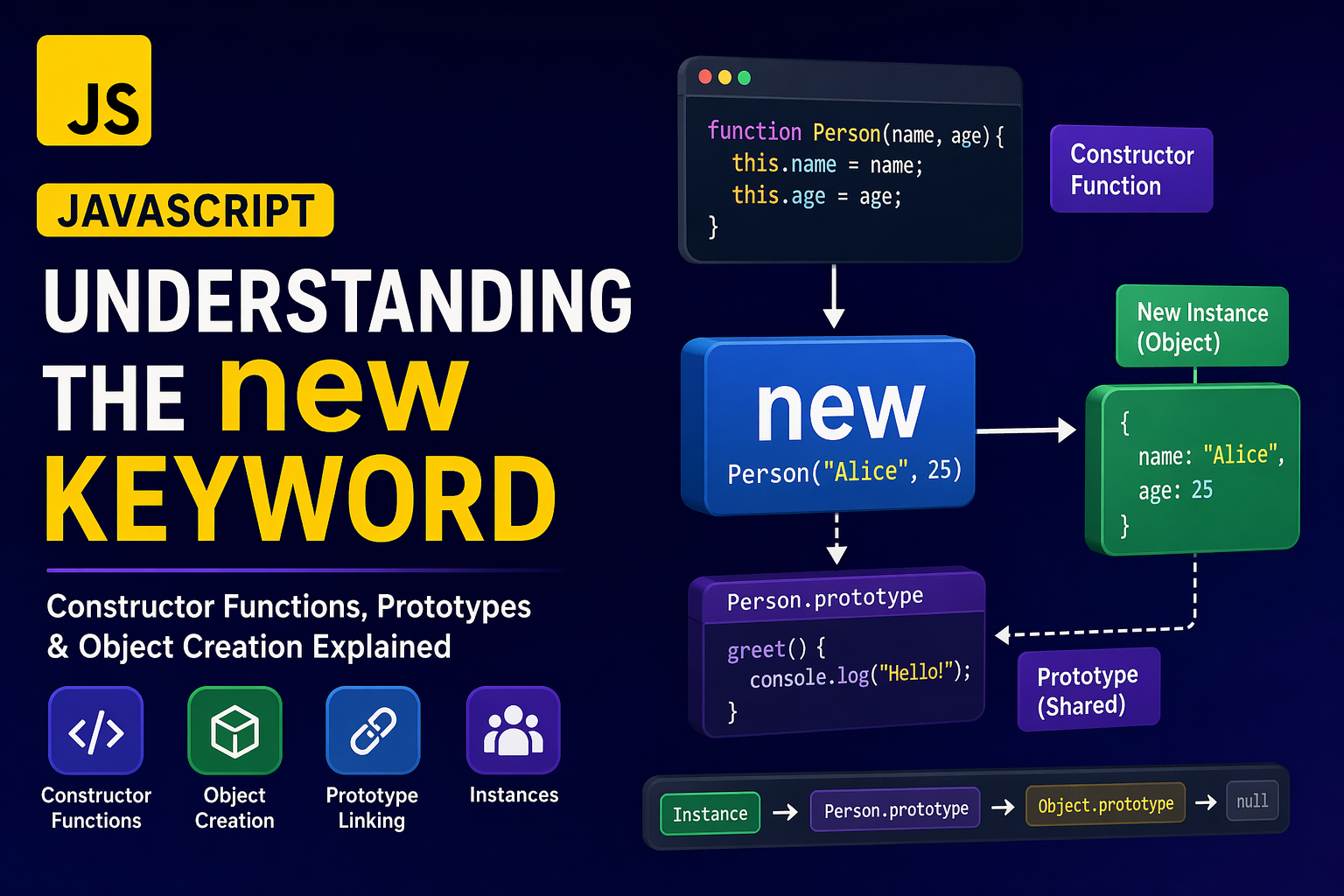
JavaScript is a powerful language, and one of its most important concepts in object-oriented programming is the new keyword.
If you've ever wondered how objects are created behind the scenes, this guide will give you a clear, step-by-step understanding of how new works.
📌 What is the new Keyword?
The new keyword in JavaScript is used to create an instance of an object from a constructor function.
👉 In simple terms: It helps you create multiple objects using a blueprint.
🧱 Constructor Functions
A constructor function is a regular function used to create objects.
Example:
function Person(name, age) {
    this.name = name;
    this.age = age;
}
Using new:
const user1 = new Person("Vishal", 20);
const user2 = new Person("Rahul", 22);

console.log(user1);
console.log(user2);
Output:
Person { name: "Vishal", age: 20 }
Person { name: "Rahul", age: 22 }
👉 Each object is a separate instance created from the same constructor.
⚙️ What Happens When You Use new?
When you write:
const user = new Person("Vishal", 20);
JavaScript performs 4 hidden steps:
🔹 Step 1: Create an empty object
const obj = {};
🔹 Step 2: Link the object to prototype
obj.__proto__ = Person.prototype;
🔹 Step 3: Bind this to the new object
Person.call(obj, "Vishal", 20);
🔹 Step 4: Return the object
return obj;
👉 Final result:
const user = {
    name: "Vishal",
    age: 20
};
🔄 Object Creation Flow
Constructor Function
        ↓
     new keyword
        ↓
  Empty Object {}
        ↓
  Prototype Linked
        ↓
   this Binding
        ↓
   Final Object Returned
🔗 How new Links Prototypes
Every constructor function has a prototype property.
Example:
function Person(name) {
    this.name = name;
}

Person.prototype.greet = function () {
    console.log("Hello, " + this.name);
};

const user = new Person("Vishal");
user.greet(); // Hello, Vishal
👉 This works because:
user.__proto__ === Person.prototype
🧬 Prototype Chain
user → Person.prototype → Object.prototype → null
👉 This is called the prototype chain.
👥 Instances Created from Constructors
Each time you use new, a new instance is created.
Example:
const p1 = new Person("A");
const p2 = new Person("B");

console.log(p1 === p2); // false
👉 Even though both use the same constructor, they are different objects.
❌ What Happens Without new?
const user = Person("Vishal", 20);
console.log(user); // undefined
👉 Problem:
thisdoes not refer to a new objectIn strict mode, it becomes
undefined
✅ Best Practice
Use new with constructor functions or prefer modern classes:
class Person {
    constructor(name, age) {
        this.name = name;
        this.age = age;
    }
}
🧩 Real-World Analogy
Think of a constructor as a blueprint of a house 🏠
Constructor → Blueprint
new→ Building the houseInstance → Actual house
🔥 Final Summary
✔ new creates a new object ✔ Links it to prototype ✔ Binds this ✔ Returns the object
🎯 Conclusion
Understanding the new keyword is essential for mastering JavaScript’s object system.
Once you understand:
Constructor functions
Prototype linking
Instance creation
👉 You gain deep insight into how JavaScript works internally.